
English| EUR
Suggested for you
More currencies
Choose a language
West of Santiago de Compostela the waymarking turns away from the cathedral and runs roughly 89 kilometres through farmland, river valleys and the cliffs of the Costa da Morte. This How Long Does It Take to Walk from Santiago to Finisterre guide sets out day counts, stage lengths and the terrain that decides them. The figures come first, the reasoning after.
Quick answer
Most walkers cover the roughly 89 kilometres from Santiago de Compostela to Cape Finisterre in three to four days, averaging six to eight hours on foot each day. Strong hikers compress the route into two long stages, while those continuing to Muxía plan five. Summer heat and short winter daylight both slow the pace. The lighthouse grounds themselves stay accessible 00:00–23:59.
Cape Finisterre is not the westernmost point of mainland Spain. Cabo Touriñán, a short distance north along the same shoreline, reaches further into the Atlantic. Roman geographers believed otherwise, and the name Finis Terrae held. That old error shaped a route: the Camiño de Fisterra is the only waymarked Camino that leads away from Santiago de Compostela instead of towards it, and pilgrims walked it long before the modern scallop-shell markers were fixed. Searches for How Long Does It Take to Walk from Santiago to Finisterre resolve into the same short answer, three or four days, but that figure hides the shape of the ground. The trail measures close to 89 kilometres from Praza do Obradoiro to the cape. Those kilometres are neither flat nor coastal for most of their length. The path leaves the city through eucalyptus plantations, crosses the Tambre at the medieval Ponte Maceira, and spends two days inland among hamlets, hórreos and wooded valleys before the ocean appears at all. Cumulative ascent, not distance, is what tires walkers: repeated climbs and descents between Negreira and Olveiroa, where the longest single stretch runs past 30 kilometres with thin services in between. The first sight of the Atlantic comes late, from the high ground above Cee, and the Costa da Morte only accompanies the trail on the final approach through Corcubión and past Santa María das Areas. The practical consequence is that a Camino Finisterre walking route demands planning at two points rather than along its whole length: the long middle stage, and the last afternoon. Fisterra town is not the finish. The Faro de Fisterra stands another three and a half kilometres beyond the harbour, uphill, past the 0.00 kilometre marker that answers Santiago's own milestones. Walkers arriving late in the day often postpone the lighthouse until the following morning; those who press on find the grounds open and free at any hour. Beds in the western villages are finite in high summer, and that scarcity is the real argument for fixing a day count early rather than improvising. Anyone still weighing how long does it take to walk from santiago to finisterre against a limited holiday should settle accommodation and onward transport first, then let the stages fall into place around it. Muxía adds a further day for those who want the wider run of Galician coastal landmarks before turning back east.
“The difficulty of this route is measured in ascent rather than kilometres, and Fisterra town is not the finish line.”
This four-day plan suits walkers with reasonable fitness who want the standard Camino Finisterre route from Santiago de Compostela to Cape Finisterre, covering roughly 90 km at 20–30 km per day. Fitter hikers compress it into three days by merging the middle stages.
Leave Praza do Obradoiro, cross the Ponte Maceira medieval bridge and finish at Negreira, about 21 km over 5–6 hours. The climb out of Alto do Vento comes early, so pace the first hour conservatively.
The longest stage at roughly 33 km and 8–9 hours, passing Santa Mariña and the Rio Xallas valley. Water points are sparse between Bruma and Olveiroa, so fill up before leaving the village.
About 20 km and 5 hours, with the Ermida de Nosa Señora das Neves and the Hórreo viewpoint where the Atlantic first appears. The descent into Cee is steep and stony underfoot.
A coastal 12 km stretch of 3 hours past Praia de Estorde and Praia da Langosteira. Collect your Fisterra compostela at the town albergue before continuing.
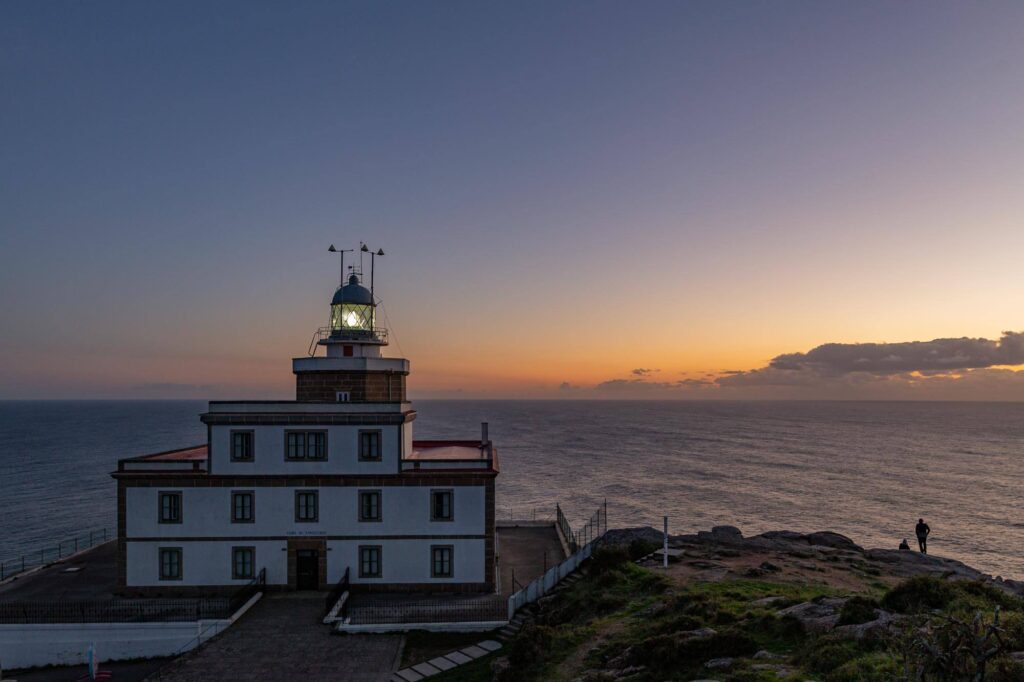
The final 3.5 km uphill takes 45–60 minutes on the CP-3404 road, ending at the Faro de Fisterra and the km 0.00 marker. Grounds are free to enter at 0 EUR.
Walk past the lighthouse to the Monte do Facho paths and the Cruz de Fisterra above the cliffs, allowing 40 minutes. Loose gravel near the cliff edge makes handrails worth using.
Merge Days 3 and 4 into a single 35 km push from Olveiroa to the lighthouse, roughly 9–10 hours. Start before first light to reach the cape with daylight to spare.
The period from May to June and September to October offers the most favorable balance of moderate temperatures and consistent daylight for walking. These months avoid the extreme heat of midsummer and the frequent heavy rainfall characteristic of the Galician winter.
Mild; 15°C–22°C. Ideal for long walking days with extended daylight hours.
Late spring provides stable weather and blooming landscapes before the peak summer crowds arrive.
Warm; 18°C–25°C. High humidity potential.
This window offers the most daylight, though coastal paths experience increased foot traffic during these months.
Cool to mild; 12°C–20°C. Lower precipitation risk.
Early autumn offers crisp walking conditions and settled weather patterns after the summer heat dissipates.
—
The lighthouse grounds are accessible 24/7, with sunset being the most popular time for visitors.
Verdict: For the most stable weather and manageable foot traffic, plan your walk during the windows of May to June or September to October.
Cape Finisterre is located on the Atlantic coast of Galicia, serving as the traditional endpoint for pilgrims. Travelers typically depart from Santiago de Compostela to reach the trailhead or return from the coast.
Camino de Santiago (Finisterre Way) from Santiago
Monbus service from Santiago de Compostela to Fisterra
AC-445 road from Santiago via AC-552
Direct transfer from Santiago to Faro de Fisterra
The lighthouse grounds at Faro de Fisterra, 15155 Fisterra, A Coruña, Spain, are accessible 24/7. Plan your arrival for sunset to experience the landmark within the best arrival window of 00:00–23:59.
The Faro de Fisterra is accessible to visitors at all times, allowing pilgrims to reach the end of their journey whenever they arrive. The grounds remain open daily throughout the week.
Accessing the grounds at the end of the walk from Santiago to Finisterre does not require a ticket. There are no admission fees for visitors reaching the lighthouse.
Verdict: A typical visitor pays 0 EUR for access to the lighthouse grounds, regardless of the time of day.
The Camino Finisterre covers roughly 90 km of Galician coast and hill country, so what you carry and wear decides whether you hold a steady daily pace or lose days to blisters.
Everything you need to know about how long does it take to walk from santiago to finisterre
Most pilgrims find that how long does it take to walk from santiago to finisterre averages between three to five days depending on your pace. The distance is approximately 90 kilometers, making it a manageable extension for those completing the Camino de Santiago.
While the terrain features moderate elevation changes, many walkers consider the trail to be less demanding than the main Camino Frances. Planning for how long does it take to walk from santiago to finisterre helps ensure you have enough time to enjoy the coastal views without rushing.
The total distance from the Cathedral in Santiago de Compostela to the lighthouse at Cape Finisterre is roughly 90 kilometers. Knowing how long does it take to walk from santiago to finisterre allows you to arrange your daily stages comfortably across the Galician landscape.
The lighthouse grounds are accessible 24/7, with sunset being the most popular time for visitors. You can plan your arrival anytime between 00:00 and 23:59 to suit your schedule.
There is 0 EUR entrance fee for the lighthouse grounds as entry is free for all visitors. This iconic landmark at the edge of the world remains open to the public daily.
Yes, the lighthouse grounds are open 00:00–23:59 every day, including weekends and holidays. This provides flexibility for travelers arriving at various times of the day or night.
If you are short on time, some pilgrims choose to cover the 90-kilometer distance by walking longer daily stages. However, most people prefer to take four or five days to fully experience the transition from the city to the Atlantic coast.